
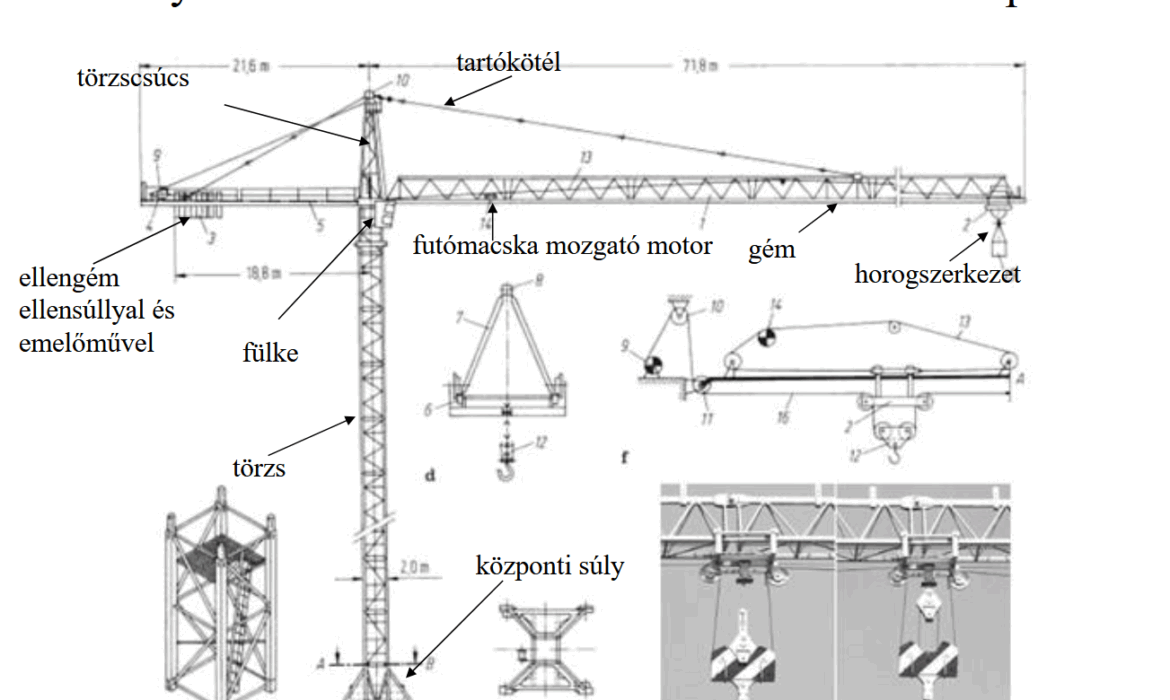
Previous in our blog post We have already discussed tower cranes and reviewed their components and how they are assembled. Now we will briefly introduce the different types.
After their introduction in the mid-twentieth century, tower cranes not only revolutionised high-rise construction, but also appeared in many other industrial fields, such as manufacturing plants or the ports. Thanks to its wide range of uses and engineering ingenuity, several types have become widespread over time, so project designers can easily find the version that allows them to perform lifting tasks as efficiently as possible.
First, the in terms of mobility two separate categories must be established.
Tower cranes can be fixed in place or movable (on a pre-built track). Secondly, they can be distinguished by according to the position of the drive performing the rotary motion.
In the case of top-slewing cranes, the drive is located above the tower structure, while in the case of bottom-slewing cranes, it is located below it. Smaller bottom-slewing cranes are also known as self-erecting tower cranes, as they are capable of erecting themselves, unlike top-slewing cranes, which require a second crane for this purpose.
The tower cranes based on their structural design They are also available in numerous versions. Let's take a look at the most common ones!
- Flat Top Tower Crane
They are most easily recognisable by the fact that the top of the mast does not extend beyond the control cab. Thanks to their small footprint and relatively easy assembly and disassembly, ideal for urban use. Due to their flat roof design, they are the right choice for work areas where several cranes are in operation and every metre counts. safely be able to move under and over each other.
- High Top tower crane
The big brother of flat-roofed tower cranes. In these structures, the top of the tower extends beyond the cabin. Due to its design, a longer counterweight and counterbalance can be installed, which makes it possible to lift really heavy loads, and the length of the boom can also be increased, which equates to a greater range. The strongest, highest load capacity tower crane type, which is an excellent choice for larger-scale construction or manufacturing processes where heavy prefabricated structural elements are used.
- Tilting tower crane
Unlike previous models, this type of boom is capable of both vertical and horizontal movement. There is also a universal version available, which is equipped with a crane trolley. Although its lifting capacity is lower than that of its aforementioned counterparts, It is ideal for use in densely built-up urban environments where there is very little space available for crane movement and load lifting.
- +1 Derrick crane
Their design differs from the lifting mechanisms listed above. In the case of Derrick cranes the tilting boom is connected to the lower part of the fuselage, forming a V shape. The boom starts from the top of the trunk with ropes move. It is commonly used in work processes where the same weight must be lifted repeatedly. As it is easier to construct, it is often installed on roofs, replacing larger tower cranes erected on the ground.
Thanks to continuous innovation and the wide range of types available, tower cranes can now be successfully used on almost any construction site. It is easy to find cranes of the right size and lifting capacity, whether for the construction of a skyscraper or the renovation of a residential building in a densely built-up, confined urban environment.