
The safety rule in the title is perhaps the best known of all the rules to follow when moving and lifting materials, but it is far from the only one. In this article, we've looked at what other important safety rules you need to follow to make your work risk-free.
Operational legislation, regulations, standards
The operating safety rules for lifting machinery, similar to other work equipment, Act XCIII of 1993 on Occupational Safety and Health, commonly known as the Mvt. is determined by.
To supplement the provisions of the Mvt., the Minister for Economic Affairs Decree 47/1999 (VIII. 4.) CTM No. published the Lifting Equipment Safety Code, which - with amendments of course - is still in force today, and further detailed provisions. In particular, it lays down rules of conduct to be observed when operating lifting machinery.
A The scope of the Code covers any lifting machinery, i.e. any mechanically or manually (manually powered) operated structure or equipment capable of lifting or lowering a load, directly or by means of an auxiliary device, from its initial position to its final position.
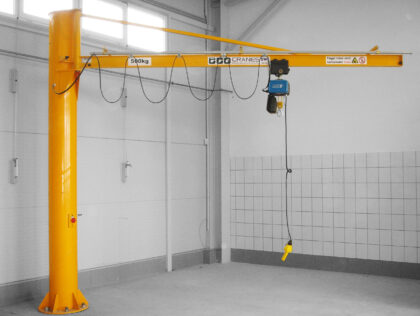
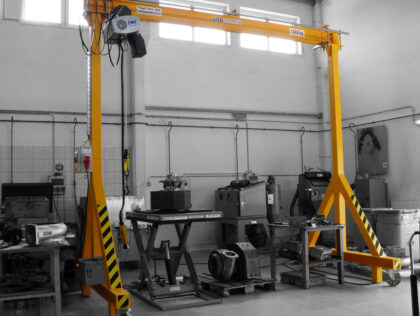
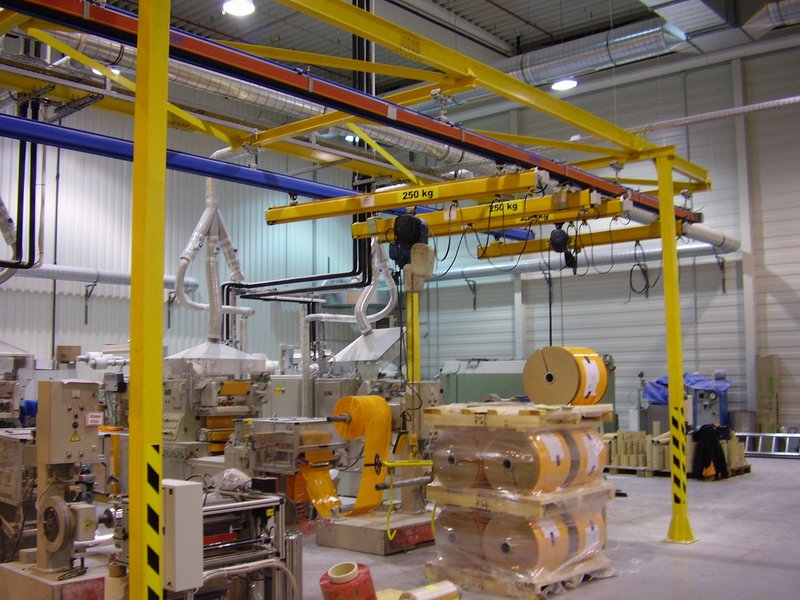
This of course includes the Eco Cranes Ltd. manufactured and distributed by most products: daruk, lifting tables, passenger and freight lifts, gerbils, lifting equipment with enclosed lifting platforms.
These are the two main pillars which, together with other smaller pieces of legislation and the requirements of standards, have created a set of rules that must be observed in the manufacture, operation, use and control of lifting machinery.
Elevation safety requirements
Of course, a full description of the rules is beyond the scope of this paper, but a few basic rules that are essential for all material handling the applicable safety standard However, we would like to highlight.
Lifting machinery must be clearly marked with its authorised capacity, which must never be exceeded.
Before starting to move the material it is also essential to check that the lifting equipment used to lift the loads is used in such a way that the lifting equipment remains stable throughout the work, taking into account the characteristics of the ground.
Very important for lifting rope, chain or strap checking the status of which can be damaged by wear and tear and ageing and cause accidents.
In the case of ropes with a high number of broken fibres, breakage and similar signs of wear the use of cranes is prohibited.
For chain in the case of visibly significant wear or deformation, replacement should be arranged.
These failures and production stoppages of cranes and hoists regular inspection and maintenance can be avoided.
Outdoors for work carried out, unless otherwise specified by the manufacturer in the instructions for use of the lifting machinery or in its logbook, or unless a lower limit is laid down by the installation technology, the 18 m/s wind speed the work must be stopped when the limit is reached.
Also work must be stopped even if extreme environmental conditions (heavy snowfall, fog or other weather or environmental effects) make the load or the immediate environment unobservable during the entire transport process.
On completion of the work, or when work breaks start, the operator of the lifting machinery must take the following measures:
- the burden safely and stable you must place;
- from Lifting machine as prescribed in the instructions for use must put you in a position;
- the controls of the lifting machinery Retrieved from you must place it in the position;
- for a lifting machine in the open air to protect against starting or shifting due to wind loads insurance must be put in place;
- you must stop the engine or the lifting machinery must be disconnected from the mains and the main switch must be locked with the safety lock (padlock) in the off position;
- prevent the lifting machinery from being unauthorised person to put it into operation.
Material handling safety rules, regulations
During material handling attention must be paid to the continuous observance of several rules:
- Ensure that the under a lifted load, and that no one is present in the danger area during lifting and lowering.
- The lifting of the load must be carried out in such a way that it is in no way not collide with other objects.
- The winch taking into account the forces must be secured against displacement.
- The the lift on a foundation of adequate strength for the load be positioned so that it cannot move or tip when lifted.
- The the height of the supporting elements of the jacks may only be increased by means of the lifting device supplied with the lift.
As every machine has different risks, it is essential to refer to the machine manual before use to ensure safe material handling.
By following the rules, regular maintenance of the cranes and lifting equipment you use will ensure that your work runs smoothly, quickly and, above all, safely.