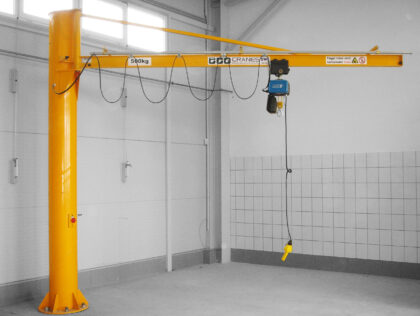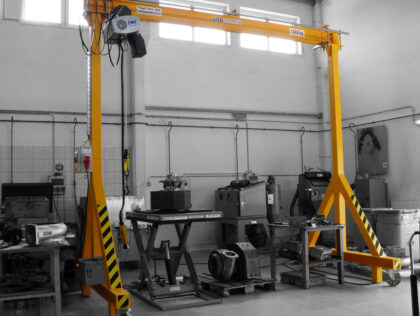

Structurally stable placement, load capacity adapted to the customer's needs, adequate power supply and electronic control: there are many criteria to be met when designing cranes (and other lifting equipment), and they are constantly interacting, so in addition to the details, the overall „big picture” must be kept in mind throughout the design process. In our latest article, we look at this crucial area in a little more detail.
Our guiding principles in design
Our design is based on three main principles: safety, optimisation for the task and economy.
We think the safety principle in the field of lifting technology needs no further explanation.
Several static and other calculation and measurement is necessary to ensure that the products we design and manufacture hydraulic lifting devices be safe from a structural, health and safety and operational point of view.
Whether it's a production hoist or a crane of unique construction or the lift is the subject of the order, our staff will always look for the solution that will allow the task to be carried out in the safest way at the most optimal operating cost. For us, this means optimisation for the task.
The more economical the production, the lower the cost. The more economical the operation, the faster the return on investment. A economy in mind when designing both the customers, and on the entrepreneurial side is essential.
The crane design process
Let's review the design aspects through the main components of cranes.
Crane holder:
The main guardians rolled from steel sections or made of sheet metal with welded cabinet construction.
Their design is decided during the design process according to the task to be performed by the device and other customer needs. For our engineers advanced design software are available to carry out the necessary calculations of load capacity, tensile strength and material requirements during the design process.
The results of these in combination with raw material prices and production costs give the basis for the cost of the crane.
Crane track:
In determining the possible crane design, the design of the crane runway, sizing and load capacity are decisive and inescapable factors, although the crane track itself is not strictly speaking part of the crane.
Wheel arch:
The wheel supports transmit the load between the crane and the crane runway force effects when moving and safely stopping the lifting device.
To do the job optimised construction and good choice of materials for long life, low maintenance, results in a structure that can be operated economically.
Gerbil:
The gerbil the maturity of its construction the basis for the reliability and lifetime of the entire crane. From expected lifetime can be ensured by proper sizing.
Electrical system:
The electrical system of the crane is the most necessary elements (power supply, control, safety equipment) too can be extended with a wide range of options.
Since each extra piece of equipment can increase operating costs and malfunction risk, it is important to accurate assessment of customer needs and keeping it under control.
Documentation:
All lifting equipment required by law accessory for the documentation, whose crane operation of must be fully available at all times during the period.
Planning is a complex process in which constant communication between the client and the contractor, matching and coordinating needs and options, is essential to create a crane that can be operated safely and economically.