
IV - Machining
As reported by Previous in our articles the industry uses the water for a myriad of purposes. acélt. In line with these uses, during the steel production process, the steel as a final product takes different shapes, which are further shaped to obtain their final form. In the final part of this series, we will discuss this stage of the process, the machining of steel.
A Machining of plain or alloy steel, can be plasticised both hot and cold. In hot working, the properties of the steel can be further modified by heat treatment. Forging, rolling and extrusion are among the best known and most common forms of machining.
Forging
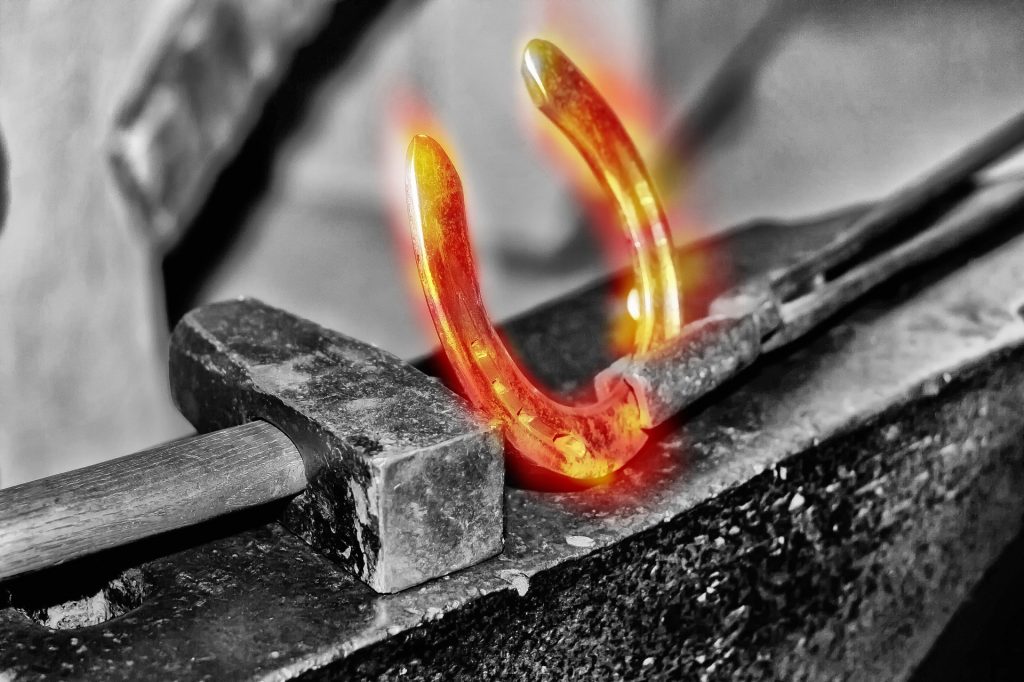
The oldest, longest-used metal deposition methods one. In forging, steel or other metals are usually shaped between the forming surfaces of two tools, using blows or pressure.
In forging, the metal can be formed hot, cold or semi-hot.
The forging of the fthe original material structure of the edges finer, so that the mechanical properties of the machined metal can be tailored to the intended stress.
Quality of forged metals after shaping by heat treatment can be further improved.
Hand forging can be used to create ornate and unique metal objects, but it is a time-consuming process.
Machine forging is faster and more efficient, although cutting costs can be high when machining smaller quantities of material.
Rolling
A much later method than forging, but capable of machining significantly larger quantities of metal, which for forming steel bars and plates perfectly suitable.
In addition to its efficiency, the rolled products have the added advantage of a wide range of shapes and sizes.
During rolling, the metal is shaped by rotating rolls on a rolling stand. A unit consisting of one or more rolling stands installed to roll a given product is called the cylinders. The rolling mill is the collective name for the rolling line and the related departments carrying out the preparatory and auxiliary operations (heating, cooling, heat treatment of the metal).
The vast majority of products machined by rolling intermediate nature, these are further developed using other technologies. Only a small part of them, such as rebars, is directly support sections, or they use the railway tracks.
The rolled products by their shape can be grouped as follows:
- Steel bars: with hollowed cylinders, hot formed, simple shaped sections (circular, square, rectangular, etc.).
- Idomacels: their section is usually compared to the shape of different letters (L, I, U, T, Z).
- Cylinder covers: products with a smaller diameter of circular section, manufactured exclusively in coils.
- Flat products: rolled discs and tapes.
- Made with special tube rolling seamless tubes.

Export
In the process of extrusion, a metal billet (usually of circular cross-section, cast or rolled) is placed in front of a squeezed through the opening by hydraulic machines.
The section of the outflow is the same as the cross-section of the orifice. The extruded profile can be solid, but can also have a wide variety of hollow shapes.
Machined steels and other metals can be cut to different sizes according to the intended use. Structural steels, plates, tubes and pipes, and malleable steels are the most common method of dismembering laser cutting, or thermal plasma cutting.