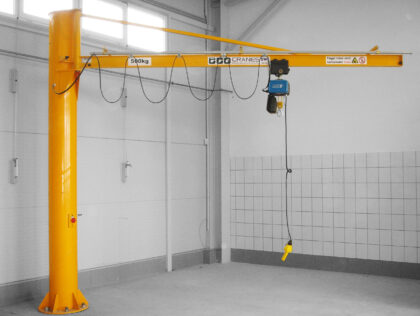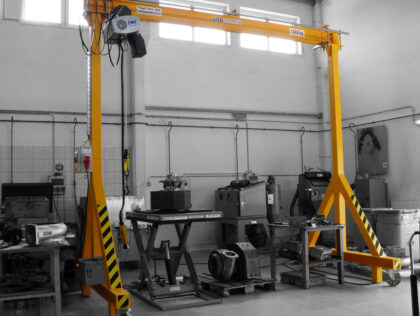


In order to make lifting loads as easy as possible, various physical mechanisms have been used for centuries. Perhaps the earliest example of this, known to everyone, is the counterweight, which requires less force and therefore less energy to lift.
What is counterbalance?
We encountered it even as children, since the seesaw found in almost every playground works on exactly the same principle as the tower cranes can also be found concrete Counterweights: by adjusting the load and the levers appropriately, we can find the point of equilibrium.
In engineering practice A counterweight is an object that helps to ensure stability and balance.. Counterweights are used in numerous applications, including the aforementioned cranes, bridges, and modern engines, for example, to reduce vibration.
In the case of lifts, they are essential components of the lifting system, as they Their use can significantly reduce the energy required to move the lift., thereby increasing the efficiency of the system.
How do counterbalances work?
Counterweights help to support loads when they are lifted or lowered. This is based on a fundamental principle of physics, the law of conservation of energy, which is one of the most widely applied laws of physics.
The law of conservation of energy states that energy is not lost, but only transformed, meaning that the total energy of a system that does not interact with its environment remains constant.
The energy in the system may be kinetic, but it may also be of a different nature, such as electrical energy, as in the case of lifts, where electrical energy is converted into kinetic energy.
However, in order for the counterbalances to In order for them to operate as efficiently as possible, two conditions must be met simultaneously.:
- they must have sufficient weight, and
- They must be at an optimal distance from the pivot point.
In physics, this is called torque, which can be calculated as the product of the counterweight's mass and its distance from the pivot point.
For the most efficient operation the counterweight torque must match the load torque. This extremely important principle must be observed with regard to the boom length and lifting capacity of (tower) cranes. definition during.
If these values are not in balance, a situation arises in which there is a risk of overturning.
Greater efficiency, more environmentally friendly operation
As they increase the energy efficiency of lift systems, counterweights help reduce the amount of energy fed into the system, which is advantageous for lifting systems environmentally friendly operation from the point of view of.
The aim is to lift loads as efficiently as possible using as little energy as possible, and counterweights are a great help in this regard.