
In the next part of our series of articles on materials used in the manufacture of lifting equipment, we will look at glass, and in particular how it is made. Let's see how the glass sheets are made, and how they are finally incorporated into the devices we design and assemble!
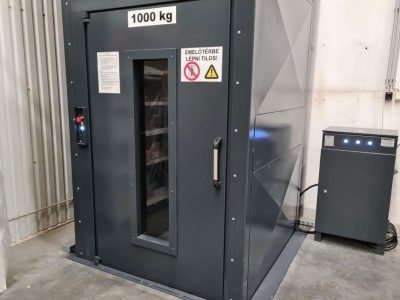
In the case of elevating structures, glass is mainly used for covering lifts or cabs, where the surface that provides mechanical protection must also be transparent.
We most often install glass surfaces to cover industrial hoists and lifts.
Although due to the lower weight of the plexi a serious competitor, as thinner boards are sufficient to achieve the same mechanical resistance and stiffness, the glass has better scratch resistance, so glass requires less extra work later to keep it aesthetically pleasing and scratch-free.
Making the glass
The glass is artificial the technique of producing has been more than Known and used for 3000 years. A mixture of glass raw materials (sand, soda ash, sodium sulphate, limestone and/or dolomite flour, boric acid, potash and various metal oxides, cullet glass) is heated and mixed in a furnace to 1200-1600 ˚C, which turns it into liquid glass.
Various additives can also be added for purification (manganese) and colouring (titanium, chromium, etc.). Very simplified, the mixture goes in one side of the furnace and the glass flows out the other, ready to be moulded.
Form
In the evolution of glassmaking several formatting techniques have evolved. One of the first of these is certainly the glass blowing, when liquid glass was shaped using a metal tube, muscle power and air blown out of the lungs.
Nowadays, with the mechanisation and mass production of glass production, this technique has mainly found in the applied arts, where the aim is to produce unique, hand-made products.
As the technology continues to evolve, many other formatting techniques have also emerged: rolling, casting, drawing, use of moulds. When it comes to making glass sheets, the most common method is the so-called swimming (floating).
This technology Patented by Pilkington in 1952 and very soon has become one of the most widely used moulding processes in the glass industry, as it can be used to produce extremely smooth and distortion-free sheets.
In this method, a melt of about 1000 ˚C is poured into a tin bath, the glass is floated on the bath and then cooled to obtain a glass sheet with a uniform surface.
Training the glass
After the glass plates are made, they can be tempered. In industrial environments, tempered glass is almost always used, which is not only more load-bearing but also safer, as it shatters into blunt-edged fragments if broken, so they are less likely to cause injury.
The glass is tempered by post heat treatment. The glass sheet is prepared (cut to size, polished, drilled) according to the application requirements, reheated to 740 ˚C and finally cooled with cold air. After cooling, the tempered glass sheet can be used as required.
Because glass is repeatedly used - either in the manufacture of new glass or granularity as a leaflet - can also be used in the sustainable materials include.