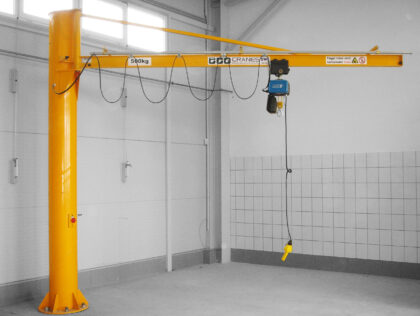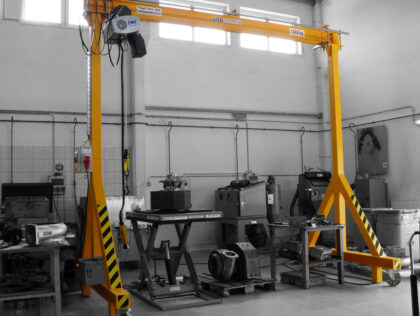

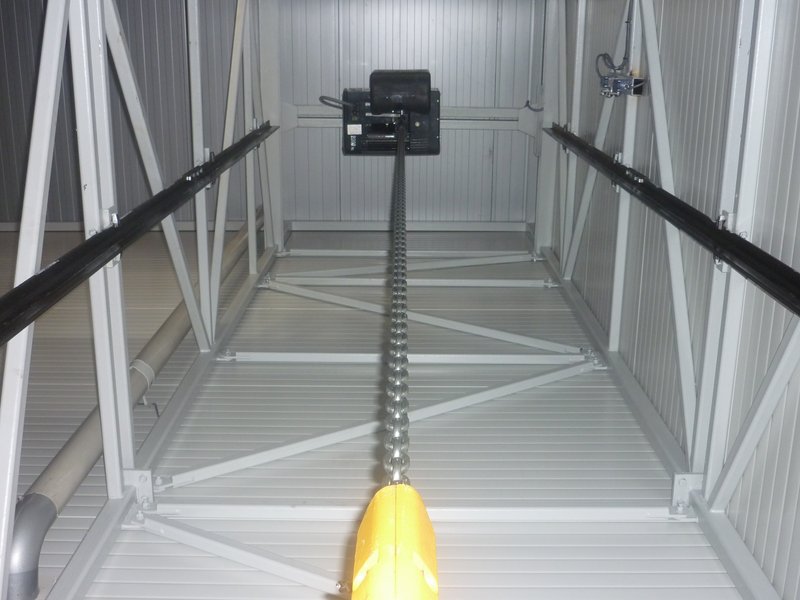
One of the most frequently asked questions in the lifting industry is whether to choose a chain or rope hoist for the job in hand. Although both are designed to lift and move loads safely, they have different load capacities and applications. In this post, we will explain the differences between the two types to make the choice easier.
Chain hoist - simple, precise, compact
Steel chain hoists with lifting chain and the load is moved through a gearbox. Available in both manual and electric versions, they are versatile. Their main advantage is compact size and precise positioning. Due to the direct vertical movement of the chain, the lifted load has less sway, which is particularly advantageous for work requiring a fine fit.
These lifts typically perform well in work processes where small to medium lifting capacities are required, but in industrial applications they can also be used for lifting loads of several tonnes. Due to their lower installation height can be used in work areas where space is limited.
Rope hoist - high performance, for industrial loads
Rope hoists move loads by means of a rope rope, which is wound on a drum. This solution provides greater mechanical stability and a longer service life even under intensive use. Unlike chain hoists, this type generally has a higher load capacity and faster lifting speed, making it a popular choice for use on production lines, in warehouses and in construction work.
It is ideal for use in high halls or even in multi-storey industrial facilities, as the wire rope allows high lifting heights.
Accuracy and manageability
In terms of accuracy chain hoists generally have an advantage. The rigid chain design and its vertical line ensure the most accurate positioning.
In contrast, in the case of wire rope, the winding generates a horizontal movement in the direction of the hoist axis, which increases with the lifting height, as the rope has to be wound around the drum several times.
Which one to choose?
A choosing the right type of lift not only for efficiency and economy - thus sustainability - question, but also affects the safety of lifting. It is therefore worth clarifying the basic issues at the beginning of the process:
- how much and how regularly will the burden be increased?
- to what height?
- how important is precise positioning?
- how much space is available in the work area?
These factors alone strongly influence whether a chain or rope hoist is the better choice, in our next post but we will also discuss three other important characteristics that influence the choice
Chain and rope hoists – summary table
| Criterion | Chain hoist | Boundary hoist |
|---|---|---|
| Lifting element | Steel lifting chain; the load is moved via a gearbox | A wire rope wound round a drum |
| Load capacity | Low to medium load-bearing capacity; in industrial versions, suitable for loads of several tonnes | Generally, a higher load-bearing capacity |
| Lifting speed | Lower | Faster lifting speed |
| Positioning | To be more precise: the vertical movement of the chain reduces the swing of the load | The winding of the rope generates horizontal movement, which increases with the lifting height |
| Installation height | Compact – ideal for use even in confined spaces | The wire rope allows for a great lifting height |
| Typical environment | Jobs requiring precision fitting, confined spaces | Production lines, warehouses, the construction industry; high-ceilinged halls, multi-storey industrial facilities |