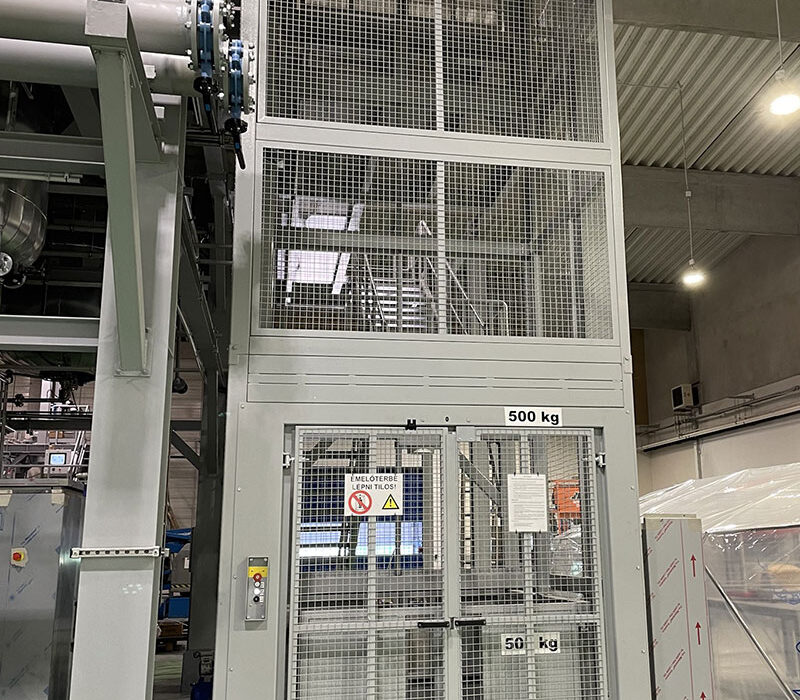
Plexiglass is an exceptionally versatile, extremely easy-to-install material that is ideal for replacing glass when the goal is to reduce weight or achieve greater mechanical resistance. We also like to use it, for example, in the construction of freight lifts. How is this polymer made and what are the properties that make it so popular in many industries?
Official name of the substance poly(methyl methacrylate), abbreviated as PMMA. Its base is methyl methacrylate. monomer, from which PMMA is produced by polymerisation. Commonly referred to as acrylic, but the most common name is plexiglass or plexiglass, which is a brand name. orig.
Its history dates back to 1928, when PMMA was already being produced in several different laboratories. The
The first brand names were registered in the early 1930s. and in the second half of the decade, this transparent plastic was already commercially available. In the United Kingdom, ICI marketed its product under the name Perspex, in the United States, DuPont marketed it under the name Lucite, and in Germany, Rohm and Haas Company marketed it under the name Plexiglass. During the Second World War, it was used, for example, in aircraft windshields., However, its civilian use only really took off after the war.. Today, plastic is a popular and frequently used material in the construction industry, the automotive industry, the advertising industry, lighting technology and even in the manufacture of medical devices.
Processing and formatting
Poly(methyl methacrylate) can be processed in several ways. Most commonly, the best-known processes in the plastics industry, namely injection moulding and extrusion are used. In these cases, PMMA is added to the manufacturing process in granule form and then moulded after melting. In contrast, in the casting process (cell cast) the components are used. The MMA (monomer) and initiator mixture are poured between glass plates and polymerised by heat treatment, so PMMA is not present as a raw material here, but is created during the manufacturing process. Generally The desired end product determines which process is used..
The finished plexiglass very well mouldable, as it can be shaped into almost any form using heat moulding. can be modified.
Other positive characteristics include easily workable, whether it's sawing, drilling, laser cutting or polishing. With acrylic adhesive, two pieces of plexiglass can be easily and permanently bonded together. interchangeable, as these chemical substances are practically the two elements are fused together.
Plexiglass has many properties that have earned it the reputation of being glass be a competitor in industrial use:
- Light transmission: high, thanks to its light transmission capacity of 92% has clear transparency, reflects little light, absorbs or scatters. It also has high UV resistance and does not yellow or become brittle even after long-term exposure.
- Mechanics: tensile and flexural strength high, therefore can withstand significant forces without breaking or cracking. As a result, panels with a much lower thickness than traditional glass can be used to achieve the same rigidity. Its impact resistance also exceeds that of glass, and in the event of breakage, it shatters into larger, less dangerous fragments. In terms of hardness, it is also comparable to glass, but the disadvantage is that it scratches much more easily, therefore it requires more care.
- Temperature: optimal range of use Between -30˚C and 80˚C Yes. It can become more brittle at low temperatures, and it begins to soften above 105 °C.
- Sensitivity: When using it, please note that certain organic solvents (chlorinated hydrocarbons, acetone) quite sensitive, as they may dissolve or damage the surface. It is not recommended for use in environments where these conditions may occur.