
In addition to the various types of mechanical hoists, the hydraulic hoist is also a very common tool used to multiply manual force, making heavier lifting tasks easier and the work more efficient. It is therefore no wonder that its different versions are widely used in industry and agriculture.
Basics of its operation
A hydraulic the most common form of lifting a a small cross-section cylinder with a piston, connected by a pipeline to another cylinder with a larger cross-section, also containing a piston.
The closed system is filled with water or oil, possibly with a special hydraulic fluid.
During operation, a piston displaced by a small force in the thin cylinder forces the liquid through to the large cylinder, which piston can also move against a much heavier load.
All this is based on the fundamental law of hydrostatics, which states that all fluids at rest, for all equal height in the point of the Print is the same and equal in all directions even if it is subjected to an additional pressure other than its own weight.
The law of the 17th century by a great French scientist, After Blaise Pascal Pascal's Law also known as.
Because the liquid is incompressible, the volume of liquid flowing out of the smaller cylinder is equal to the volume of liquid flowing into the larger cylinder.
The volume of fluid displaced by the displacement of the smaller piston is transferred to the larger piston, resulting in a smaller displacement there.
We do not save work, because the energy that can be extracted is always equal to the work invested (another physical law: the principle of conservation of energy), lifting the load is still easier. Especially if the hydraulic lift is operated by a pump rather than by hand.
Many advantages, widespread use
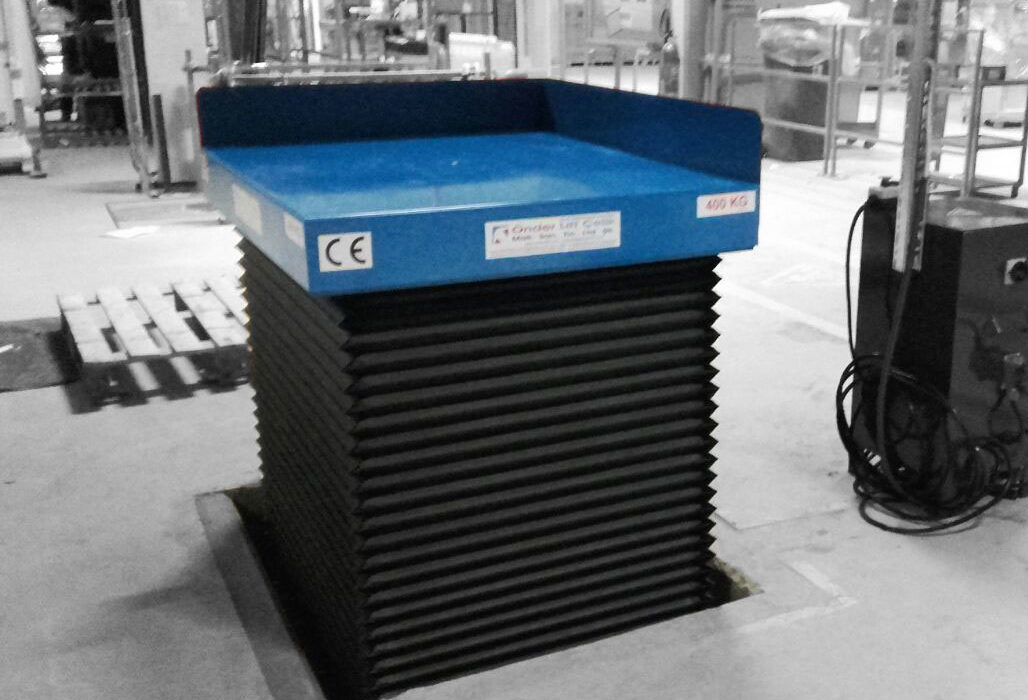
The simpler manual hydraulic lifters were followed by more complex versions, in which the fluid is moved by a pump and its flow is controlled by valves.
This solution easy handling, greater precision and safe working is made possible by hydraulic lifts.
The widespread use of this type of lift is therefore fully justified. Besides domestic use, hydraulic lifts of various sizes and capacities can be found
- in agriculture,
- in the warehouses,
- in the construction industry,
- in mechanical engineering,
- in the metallurgical industry
equally.
Since on this principle more tools works (hand pallet trucks, pallet jacks, firefighters' hydraulic scissors, flatbed trucks' backs), anyone with their eyes open will soon find themselves surrounded by a hydraulic lift.