
Our final post in our series on the basics of container transport by water will look at the lifting equipment used in ports. Previously we looked at how the specialised container transport boats, and how load up them. Now let's see what lifting equipment is used for this purpose.
The continuous development of crane technology is an essential factor in the spread of transport using metal containers around the world and the millions of uniformly sized containers that travel the world's seas and oceans.
They have been used since the beginning of shipping harbour cranes for loading, they are constantly have evolved and further specialised from the 1950s with the advent of standardised 20 and 40 foot standard containers.
From boats to shore and back
A one of the most distinctive features of commercial ports is the huge loading docks along the coast.
They are also known as STS (Ship to Shore). They are often seen in groups to minimise loading time.
They can be fixed, which can carry heavier loads, or mobile versions, which move along the coast from one boat to another on rails or wheels.
The main task of these cranes is to move containers between the shore and the ships. There are low and high profile versions, in the latter case the boom can be raised.
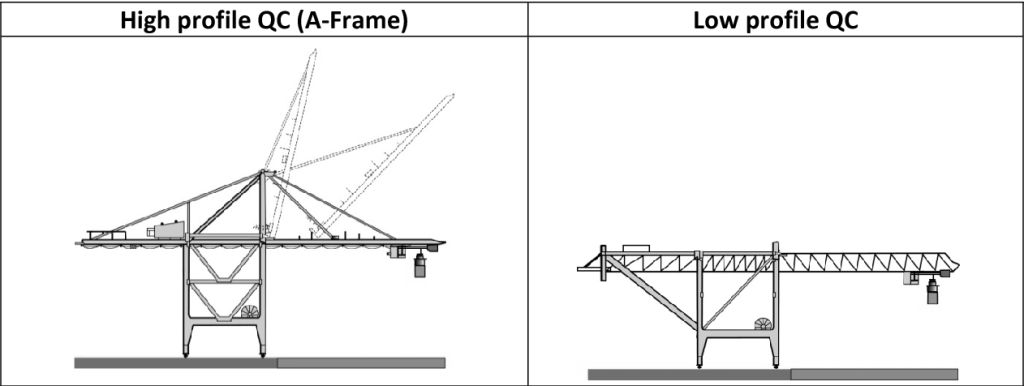
The booms of these hoists extend above the ships and move the containers from the shore to the ship or vice versa along this length. As a freight receiver a special frame (spreader) is used, to which the corners of the 20 and 40-foot containers are attached and then lifted.
The lifting capacity of the STSs varies, with models that can lift two 20-foot containers at the same time capable of 65 tonnes.
The newer models can handle up to 120 tonnes, the equivalent of four 20-foot containers or two 40-foot containers.
Not just from the coast
On rare occasions, metal boxes can be loaded and unloaded from the container ship itself or from special floating cranes. These solutions are typically used when there is no lifting equipment in the port that is suitable for the size of the container ship.
A cranes mounted on ships however, it should be noted that such instruments are only found on smaller size class container ships (less than 10% of the total container ship fleet), because although useful in smaller ports, the equipment, maintenance and their operating costs mean that they are fitted on few ships.
System access
Of course, cranes are not only used for loading and unloading from ships. Moving, transhipping and sorting containers within the port also requires lifting equipment.
For these tasks, they use wheeled equipment such as spreader cranes or the aforementioned spreader-equipped rough terrain cranes, which can transport a container over a greater distance and even forklift also have a function.
Also in the larger ports, container yards they prefer to entrust the work to gantry cranes on rails or wheels, which are ideal for lifting incoming or outgoing containers to their storage location or to the next vehicle.
It is therefore worth keeping an eye on the ports, because the constant movement of containers, which make up a significant part of the world trade operation, is clearly visible.
Image source: Pixabay - wasi1370