
Our series of articles on the steel production process in the first part we stopped there, where the hot, liquid pig iron was drained from the iron ore after the reduction processes in the blast furnace. Let's see how pig iron becomes steel!
Definition of steel
One of the most important raw materials for industry, from steel an alloy of iron and carbon, containing up to 2.06% of carbon (known in metallurgy as carbon).
A carbon content essentially determines the properties of steel in use, so one of the primary tasks in steel production is to keep the carbon content of the finished steel within the narrowest tolerance range of the desired value.
In addition to the carbon content, other pollutants such as minimising manganese, silicon, sulphur and phosphorus is also of paramount importance in the process.
Relatively small amounts sulphur also noticeably increases the tendency of steel to crack for higher temperature applications and machining. A phosphorus and the steel rideged and reduces its elasticity, making it unsuitable for daruk or lifts for the production of.
Since nowadays only they produce liquid steel, the procedures are called process target procedures. The heat required to maintain the steel in a liquid state is provided by the oxidation heat of the reactions or external energy.
Overview of the steel production process
Unlike pig iron production, which was described in more detail in our last article, steel production is not a reduction process, but an oxidation process. In steelmaking, the rawvasin the carbon is reduced by oxidation, i.e. by burning it off.
The steelmaking process basically consists of three stages:
- The metallurgical process first phase a update, during which a significant proportion of the coal is burnt out. The basic method of upgrading is to blow air or pure oxygen through the molten pig iron, so that dissolved carbon and other substances reacting with oxygen combine to form insoluble oxides. The resulting carbon dioxide bubbles and the oxides leave the solution in the slag.
- A second phase a deoxidation, which is the removal of iron oxide produced in the pig iron bath. Deoxidation is also known as quenching of liquid steel. This name is given to it because the in undamped steel the carbon reduces iron oxide with the formation of carbon monoxide in the hot gas state, which causes the hot gas emission of the melt to „boil”, „restlessness". A relatively simple and effective metallurgical method of reducing iron oxide (and, in parallel, nitrogen content) is to are converted into a compound insoluble in steel, i.e. precipitated.
- A third stage in the steel industry alloy. We will write more about this in the next and final part of our series.
Equipment for steel production
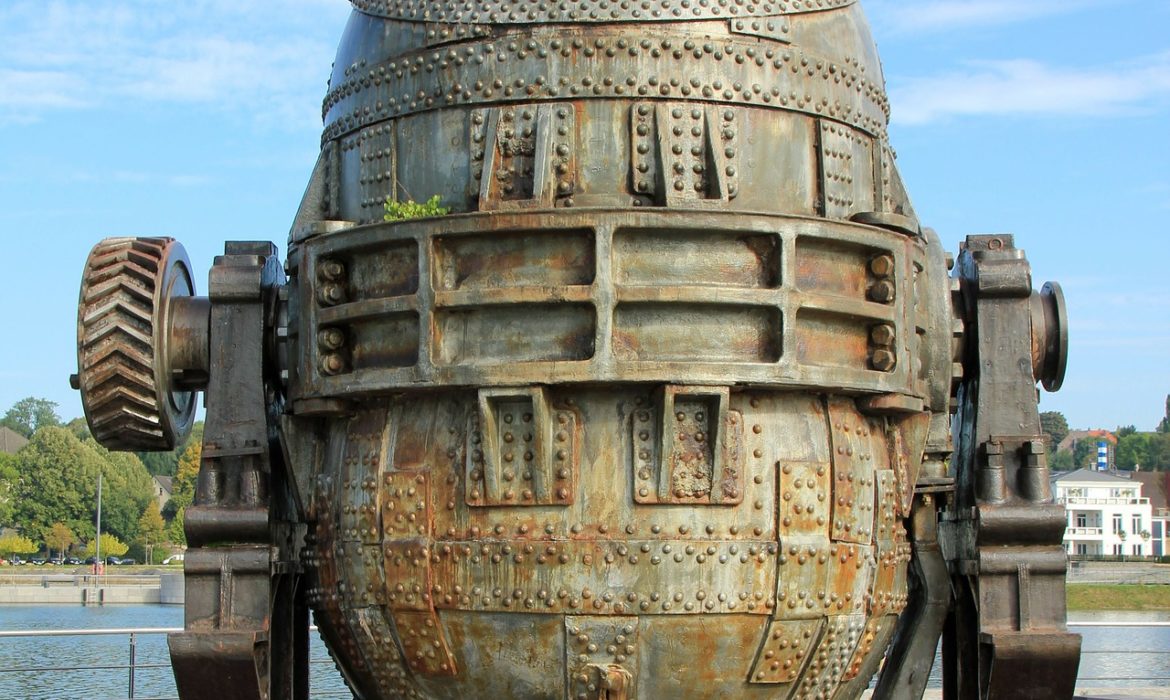
The steel industry In 1856 Henry Bessemer revolutionised the steel industry when it developed the converter to produce cheap, mass-producible steel.
With steel jacket and tiltable acid-chemical insulating material furnace at the bottom of the furnace through nozzles, bubbles of air entering the metal bath burn off the coal.
One of the great advantages of the procedure is that no fuel needed to keep the metal bath in a liquid state, as the heat of oxidation is sufficient.
To avoid overheating, iron waste (10-15%) is added to the converter. The nitrogen content of the injected air will make the steel produced more susceptible to ageing.
A converter steelmaking was adapted for mass production in the 1950s, in line with the requirements of the time. This was achieved by using pure oxygen for the upgrade, rather than air, so that the metal bath was not exposed to nitrogen.
The procedure is Linz-Donawitz steelworks developed by, therefore LD procedureis called. Steels produced by the LD process are low in gas, extremely clean and tough.
Excellent for use in the manufacture of rolled and drawn cold-formed products, the LD process has therefore become a common steel production method worldwide.
Developed to meet today's requirements, the electrical steel production, in which the high-frequency alternating current in the induction coil surrounding the arc furnace is converted into heat through the resistance of the liquid bath, thus melting the metal.
The process has the advantage of electricity does not cause pollution in the bathroom. In the changing electric field, the metal bath is in constant motion, which also helps to equalize the differences in concentration and temperature.
Today the time-consuming and highly polluting processes have been replaced by oxygen upgrading converter and the electrosteel process.
The steel thus produced meets the requirements for base steels. However, with further refining and alloying crane manufacturing quality and stainless steels can be produced to meet the requirements of the EU.