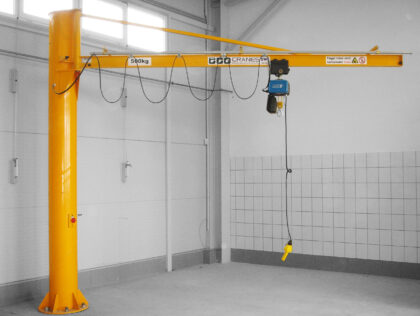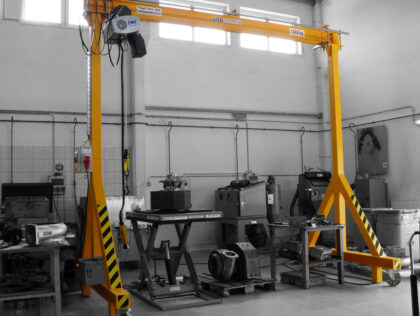

Overhead cranes and gantry cranes perform the same task – the precise and safe movement of heavy loads – yet they operate according to two fundamentally different principles. In practice, they are often lumped together, yet the choice between them is not a matter of personal preference: the building’s characteristics, the nature of the work area and the long-term running costs largely determine the right choice right from the drawing board.
What is the real difference?
The overhead structure of a bridge crane: the crane bridge moves along a track mounted on the building’s supporting columns or beams; in other words, the building itself provides the support.
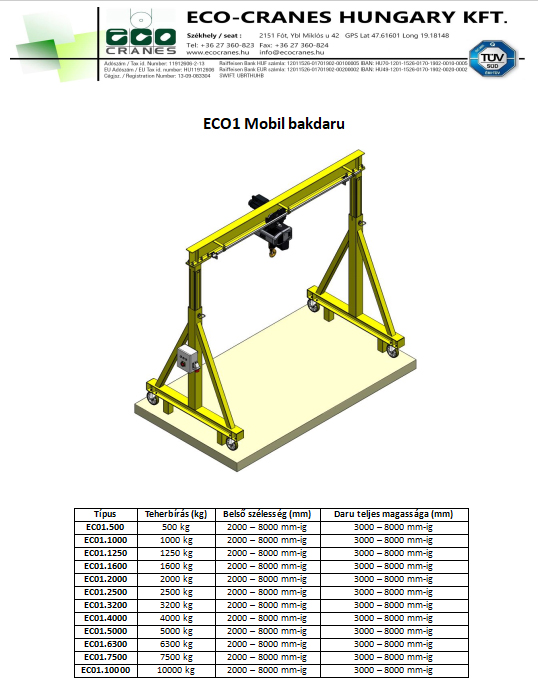
In contrast, the trestle crane is self-supporting: the bridge is supported by two „trestle”-shaped legs, which roll along a track laid at ground level and running beneath the structure. As a result, the operation of the trestle crane is entirely independent of the building’s load-bearing capacity – it merely requires a structure of sufficient strength concrete base is required for this.
To put it simply: a bridge crane rests on the building, whilst a gantry crane stands on its own.
When is which one worth it?
The bridge crane This is the better option where the hall is already suitable for this purpose, or where the necessary supporting structure can be incorporated during the design phase: this allows the entire warehouse or hall area to be utilised freely, without columns or supports, and it is typically the tried-and-tested solution for applications involving the heaviest loads, often amounting to several tens of tonnes.
In return the installation It requires a longer design process, as the building is also subject to greater loads.
The backhoe loader In contrast, it offers a quick and cost-effective solution where there is no existing crane-rail-compatible building structure, or where the investment does not justify the installation of an overhead crane – this could be anything from a workshop hall to an open loading area.
In the case of larger applications, typically those in outdoor settings – such as ports or industrial sites – particular attention must be paid to the wind load and the vagaries of the weather as well.
In a portable version, roller Thanks to its undercarriage, it can even be moved between sites, which is an advantage where the work area changes from time to time.
Common regulatory framework
It is important to note that the safety requirements for these two types of crane are governed by a single, common European standard, the EN 15011 as it is organised, this is also mandatory in Hungary, since, as a member of CEN, our country is obliged to adopt the harmonised standards.
The standard It examines the same risks (movement along the track, skewing, load sway) for both types, but based on different supporting rationales.
This also indicates that the two solutions are, in fact, similar in nature, rather than competitors.
Gantry crane or jib crane – summary table
| Criterion | Briddaru | Bakdaru |
|---|---|---|
| Supporting evidence | It moves along a track mounted on the building’s supporting columns or beams – the building provides the support | Self-supporting: the bridge is supported by two „trestle”-shaped piers, built at ground level on a track laid beneath it |
| Claim against the building | The hall must be suitable from the outset, or the supporting structure must be incorporated at the design stage | It is independent of the building’s load-bearing capacity; a concrete sub-base of sufficient strength is required |
| Land use | The entire warehouse or hall area can be utilised freely, without any columns or supports | The legs and the ground-level track take up space |
| Typical application | Applications with the highest load-bearing capacity, often amounting to several tens of tonnes | Where there is no crane-compatible building structure: workshop hall, open loading area |
| Installation | It requires a longer planning process and places a greater load on the building | A quick and cost-effective solution |
| Transferability | Attached to the building | Available in a mobile version with a roller chassis, it can be moved between locations |
| Outdoor use | – | Particular attention must be paid to wind loads and adverse weather conditions |
| Standard | EN 15011 | EN 15011 – a common European standard for both types |
The EcoCranes approach
At Eco-Cranes, we design and manufacture both types, tailored to individual requirements: we recommend overhead cranes where the building’s characteristics and load-bearing requirements justify it, and mobile tower cranes where flexibility and rapid, building-independent installation are the key considerations.
If you are unsure which one is suitable for your business, Please feel free to contact us – Our experts will help you find a solution that really pays off, based on the conditions at the site.
Do you have any further questions about the cranes or the selection process? Please call us: +36-27-360823