
The greatest enemy of cranes, hoists and steel structures in general is not the load, but corrosion. A structure’s load-bearing capacity is guaranteed by its engineering design, whilst its long service life is ensured by surface protection. To this day, hot-dip galvanising remains one of the most effective ways of ensuring that steel can withstand rust for decades with virtually no maintenance.
What exactly does galvanising mean?
It is worth clarifying this concept, as many people misunderstand it. In a professional sense Galvanising is an electrolytic coating process: a thin layer of metal is deposited onto the surface of the metal using an electric current from a solution of metal salts. In everyday language, however, galvanising is generally equated with the application of a zinc coating to steel, i.e. hot-dip galvanising.
There are two main types of galvanising. The electrolytic galvanising uses an electric current to form a thin layer of zinc, 5–20 microns thick, primarily for smaller components. The hot-dip galvanising The steel is dipped into molten zinc, resulting in a thicker coating of 50–150 microns – this is almost always the method used for larger structures, including cranes.
How does hot-dip galvanising work?
The success of the process depends on the preparation: zinc only adheres properly to a clean surface. The steel is first degreased in an alkaline bath, then the rust and the rivet. The cleaned component, which has been treated with a flux, is then immersed in a molten zinc bath at a temperature of approximately 450 °C, where the zinc penetrates the surface and forms a layer of iron-zinc alloy.
The galvanised coating therefore It does not simply adhere to the steel, but becomes an integral part of it – which is why it is much more resistant to scratches and knocks than a coat of paint.
Three types of protection at once
The coating at the same time protects the steel in three ways: it acts as a barrier, isolating the metal from moisture and air; as a so-called sacrificial anode, it provides additional protection, as in the event of damage, the surrounding zinc corrodes instead of the steel; finally, over time, it forms a dense patina layer, which further slows down corrosion.
A hot-dip galvanised structure can therefore remain maintenance-free for decades – even for over fifty years – whether outdoors or in an industrial environment. Moreover, the hot-dip process also coats the interior of hollow sections, where paint cannot reach.
Galvanising and painting: the duplex system
Galvanising and painting are not alternatives, but complement each other. Their combined use is known as a duplex system: a topcoat of paint or a powder-coated layer is applied to the galvanised surface. The zinc protects the paint from peeling, and the paint protects the zinc from wear and tear, so together they offer a lifespan one and a half to two times longer than they would individually.
Why is this important in crane manufacturing?
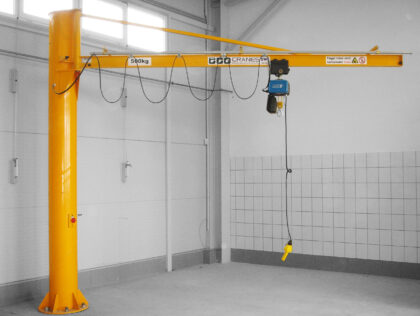
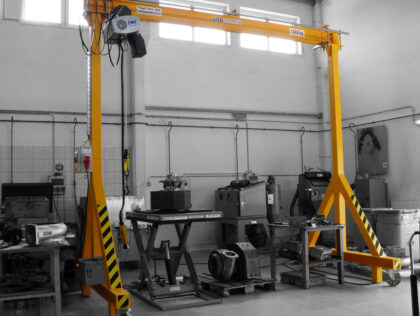
An overhead crane, gantry crane or outdoor slewing crane operates for decades, often in environments that are damp, dusty or contaminated with chemicals. Surface protection in this context is not merely a matter of aesthetics, but the foundation of safety and return on investment – a decision that must be made right from the design stage.
The At Eco-Cranes Complex metalworking covers the entire process: the with granular spray from achieving a metal-clean surface preparation to a durable, powder-coated right down to the coating. If you, too, need a crane or hoist that will serve you reliably and rust-free for many years, Please feel free to contact us – We also tailor the appropriate surface protection to your requirements.