
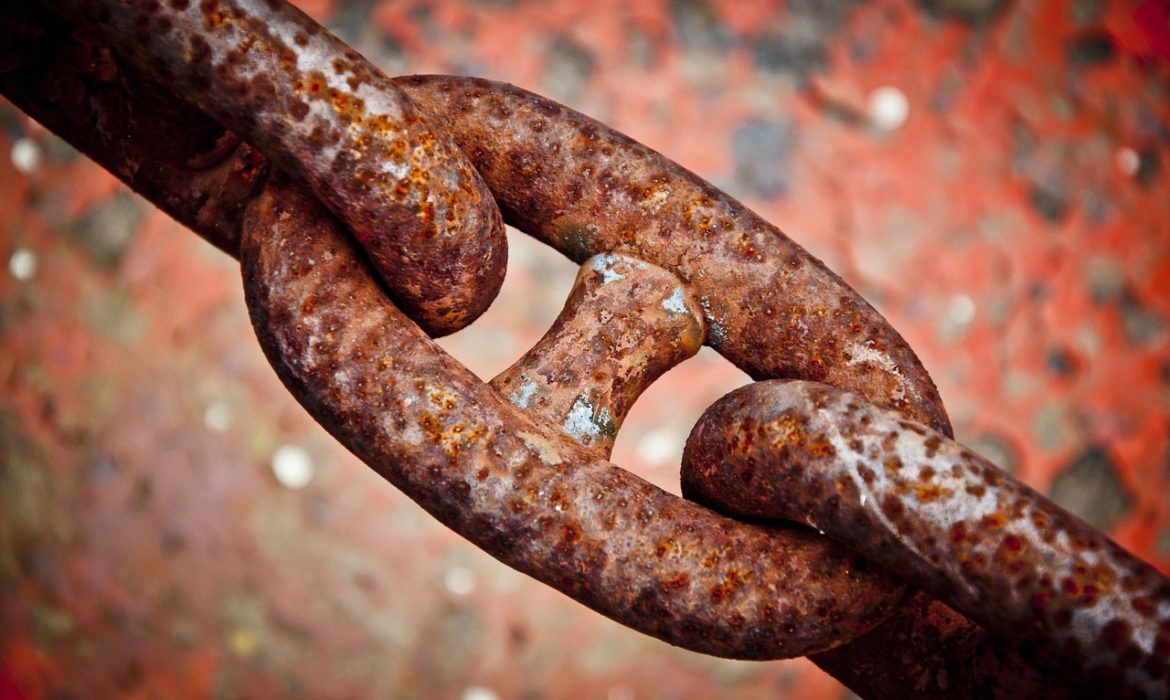
It plays a significant role in the aesthetics of certain industrial or modern buildings, but in actual industrial environments, its presence is far from pleasant and is much more of a concern. Let's see how rust, the relentless destroyer of metals, works!
The chemistry of rust
Everyone knows that, What is rust: reddish-brown substance, which is used to produce various metals, mainly iron and the steel It forms on the surface as a reaction to prolonged exposure to moisture and oxygen. That is the everyday explanation.
The scientific name for rust is iron oxide.. It is formed as a result of a complex chemical reaction in which iron or steel (Fe) reacts with atmospheric oxygen (O2), during which reaction iron oxide (Fe2O3 or Fe3O4) is formed. In this reaction, water acts as a catalyst, which means that the process takes place faster in a wet environment. The explanation for this is that moisture promotes the flow of ions, thereby enhancing the oxidation process.
Not welcome everywhere
While rust may evoke a vintage aesthetic in certain contexts, its presence on functional metal objects is rather problematic.
Rust weakens the structural integrity of metal., thus reducing their quality.
This deterioration can compromise the performance and service life of metal objects, from tools and machinery to structural components.
What's more, rust is not just an aesthetic problem, but also may also pose health and safety risks. For example, rusty metal on playground equipment or outdoor furniture poses a risk of injury due to sharp edges or weakened structures. Cranes and other lifts in the case of rust The load-bearing capacity and tensile strength of weakened structures may be significantly reduced compared to factory values., which makes working with them hazardous.
In order to reduce such risks, safety rules include visually inspecting work equipment before it is used.
Removing rust
The best thing, of course, is prevention. rusting before it occurs, for which a dry environment or the application of various anti-corrosive coatings to metals is the appropriate solution.
However, all is not lost even if the voracious monster has already reared its head.
The most obvious method is mechanical removal, ranging from the use of wire brushes and sandpaper to shot blaster may extend to the use of machines.
A chemical rust removal methods do not cause significant wear to the metal, so in some cases they may be the only solution. The active ingredients used in such processes contain acids that dissolve rust without damaging the metal.
The electrolysis Perhaps the most complex and expensive technique, in which the corroded metal object is immersed in a solution and subjected to an electric current, causing the rust to detach and migrate to an anode. This method is like removing the rust in a controlled manner so that the metal underneath reappears rejuvenated.
Corrosion can therefore be prevented with some effort, but constant attention is required to ensure that rust does not win.