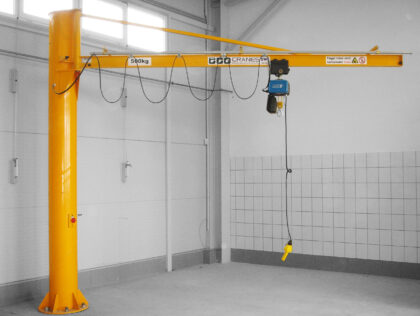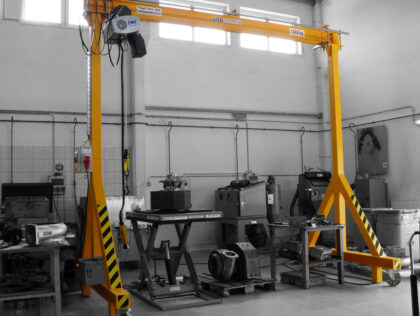

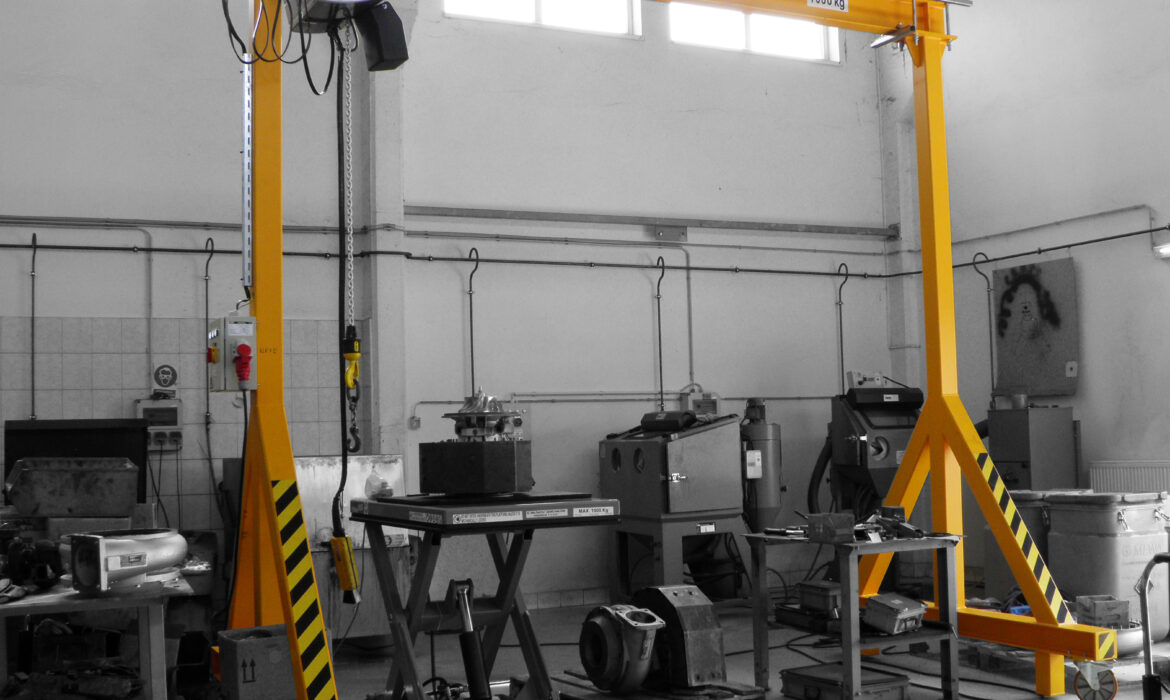
A load weighing several tonnes suspended in the air leaves no room for error. When designing a crane, it is therefore not enough to know simply how much weight it needs to lift. It is also necessary to determine how often it will be used, what loads it will be subjected to, how it will be inspected, how it will be operated; and what happens if something goes wrong.
This system is provided by the crane standards.
Not just a single standard, but a whole system
At an international level, the ISO 4301-1:2016 (Cranes – Classification – Part 1: General) one of the fundamental documents. Cranes and their mechanisms are selected on the basis of the operating conditions and the intended work cycles, classifies them on the basis of the load spectrum and the average displacements.
This is important because a crane that carries out a few hundred lifts a year and an industrial crane that operates continuously are subjected to entirely different stresses.
The European standard for design: EN 13001
One of the most important sets of standards for crane design in Europe is EN 13001, which is published in Hungary as MSZ EN 13001.
The MSZ EN 13001-1:2015 (Cranes. General design. Part 1: General principles and requirements) It sets out the general design principles necessary for the prevention of mechanical hazards associated with cranes. According to the MSZT, this standard must be applied in conjunction with the other parts of EN 13001.
The series of standards is constantly evolving: for example, the MSZ EN 13001-3-5:2026, which regulates the limit states of forged and cast crane hooks and the verification of their conformity. The MSZ EN 13001-3-6:2026 standard has also been published, which deals with the mechanical limit states of hydraulic cylinders used in the load-bearing structures of cranes.
Bridge and gantry cranes: specific requirements
An overhead crane operating in an industrial hall is a completely different type of structure to a mobile or tower crane. The MSZ EN 15011:2021 (Cranes. Bridge and gantry cranes) It deals specifically with the safety requirements for bridge and gantry cranes that move on rails or by other means, or that are fixed in place.
The new international ISO 12480-5:2026 yet it specifically sets out requirements for the safe use of bridge and jib cranes, when applied in conjunction with ISO 12480-1.
It’s not enough just to plan – you also need to check
Crane safety does not end once the crane has been manufactured. The ISO 9927-1:2013 (Cranes – Inspections – Part 1: General) sets out the general inspection requirements for cranes.
And for safe operation, the ISO 12480-1:2024 (Cranes – Safe use – Part 1: General) provides the international framework. The standard covers everything from planning the task to the selection, installation, operation and maintenance through the operators, knitters and deals with safe working practices right up to the selection of transmitters.
And what does all this mean for Hungary?
In Hungary, the key legal document governing the use of cranes is the Decree No. 47/1999 (4 August) of the Minister of Finance, which contains as an annex the Safety Regulations for Lifting Equipment (EBSZ). This is not a standard, but a set of mandatory legal requirements.
A Standards and legislation therefore play different roles: legislation sets out the mandatory legal framework, whilst EU regulations (e.g. the Machinery Directive 2006/42/EC and the (EU) 2023/1230 Machinery Regulation) and technical standards provide detailed guidance on design, manufacture and operation.
The crane’s actual safety system
A safe crane is therefore not based on a single standard, but on a system comprising standards, legislation, engineering calculations, tests and suitably qualified personnel.
A crane’s load capacity is only part of the story. Equally important are the load class, the structural design, the condition of the hook and rope, the safety devices, the inspections and the method of operation. Ultimately, all crane standards serve the same purpose: to ensure that loads weighing several tonnes can be moved – whilst keeping people safe.
Our company designs cranes in accordance with industry standards and manufactures and installs them accordingly. Please get in touch to find out how we design and manufacture cranes for your company. Eco-Cranes Ltd. – +36-27-360823 - info@ecocranes.hu